NightSense Streetlight
A responsive lighting system for women’s perceived safety at night
RCA × UK Government Office for Science / Co-Lab
Complex Systems Studio Project
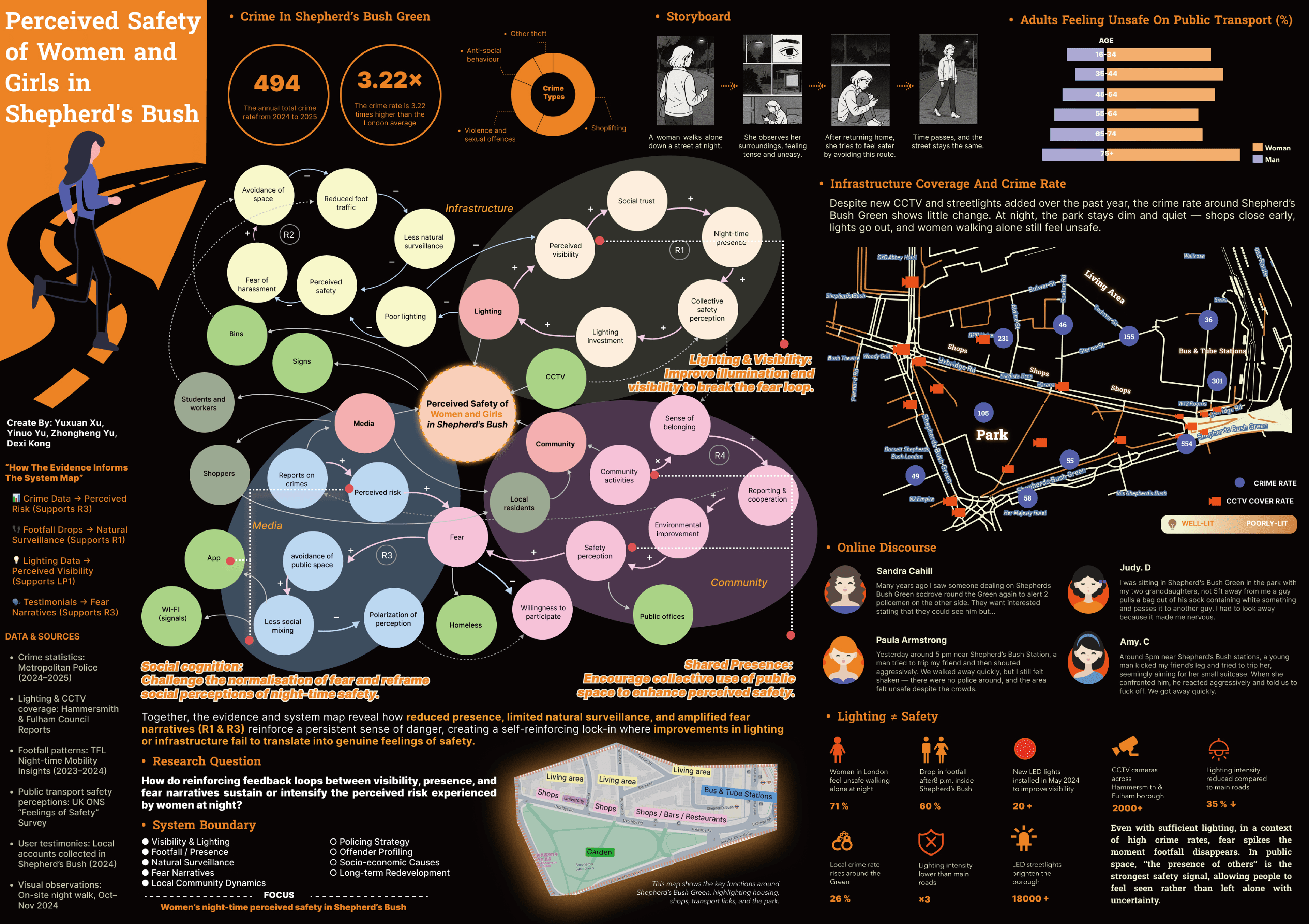
NightSense Streetlight was developed within a Complex Systems project exploring women’s perceived safety around Shepherd’s Bush Green at night. The project focused on how safety is shaped by visibility, uncertainty, social presence and the way people read their surroundings.
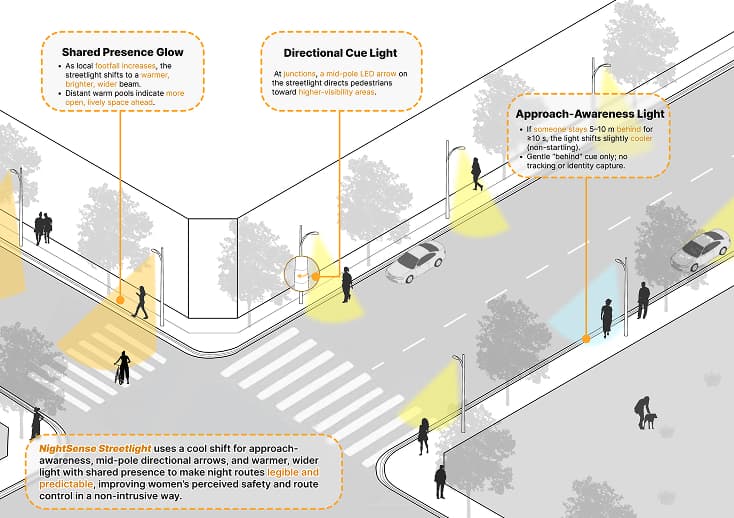
My focus was a responsive streetlight prototype. Without using cameras or identity tracking, NightSense uses subtle changes in light to communicate situational information, helping people feel more aware, supported and in control.
Research Insight
The research showed that perceived safety is not only about the amount of light in a place. A street can be lit, but still feel unsafe when people cannot understand what is happening around them.
This shifted the design focus from brightness to communication. I began to ask how a familiar urban object, such as a streetlight, could become a gentle touchpoint that gives people information about approach, direction and shared presence.
Strategy & Leverage Points
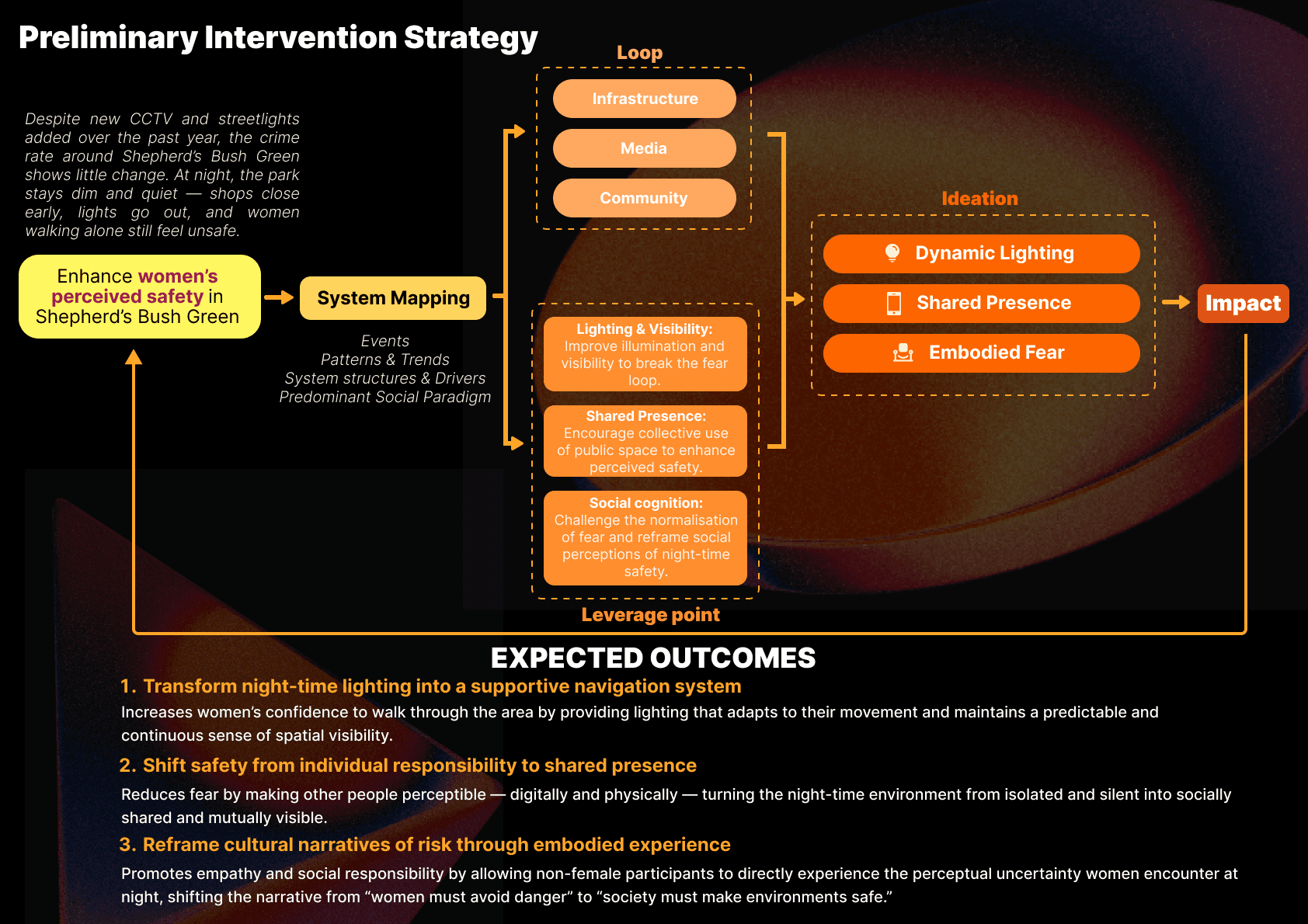
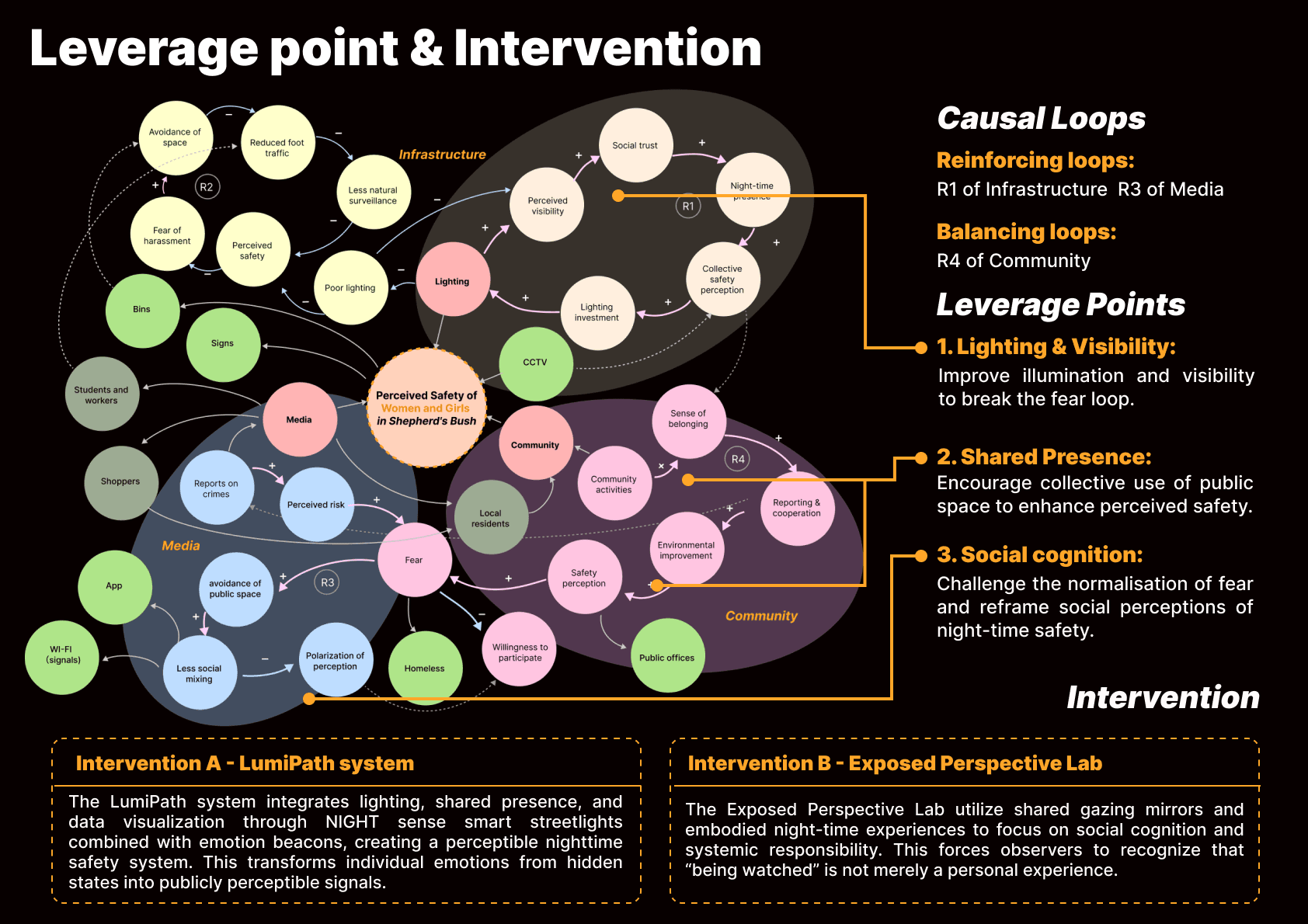
Through system mapping, the project identified lighting and visibility, shared presence and social cognition as key leverage points. These points helped move the project from a broad safety issue towards specific design interventions.
NightSense focused on the lighting and visibility pathway, using streetlights as existing urban infrastructure that could respond to moments of uncertainty without creating a sense of surveillance.
Prototype & Testing
I built a simple Arduino prototype to test whether colour temperature could work as a safety signal. A sensor input controls an LED, allowing the light to shift between different states. The change is designed to stay gentle and stable, avoiding sudden flashing or alarm-like signals.
The prototype explored three light languages: a cooler shift when someone approaches from behind, a neutral directional cue at crossings, and a warmer wider glow when more people are nearby. A short user test suggested that cooler light was often read as caution, while warmer light was associated with calm and welcome.
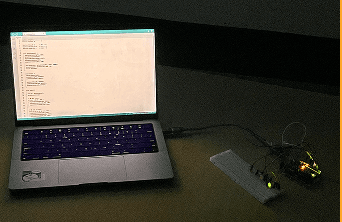
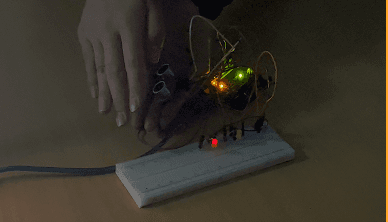
Arduino Circuit Test